
The garage that helped build Porsche’s Le Mans legacy
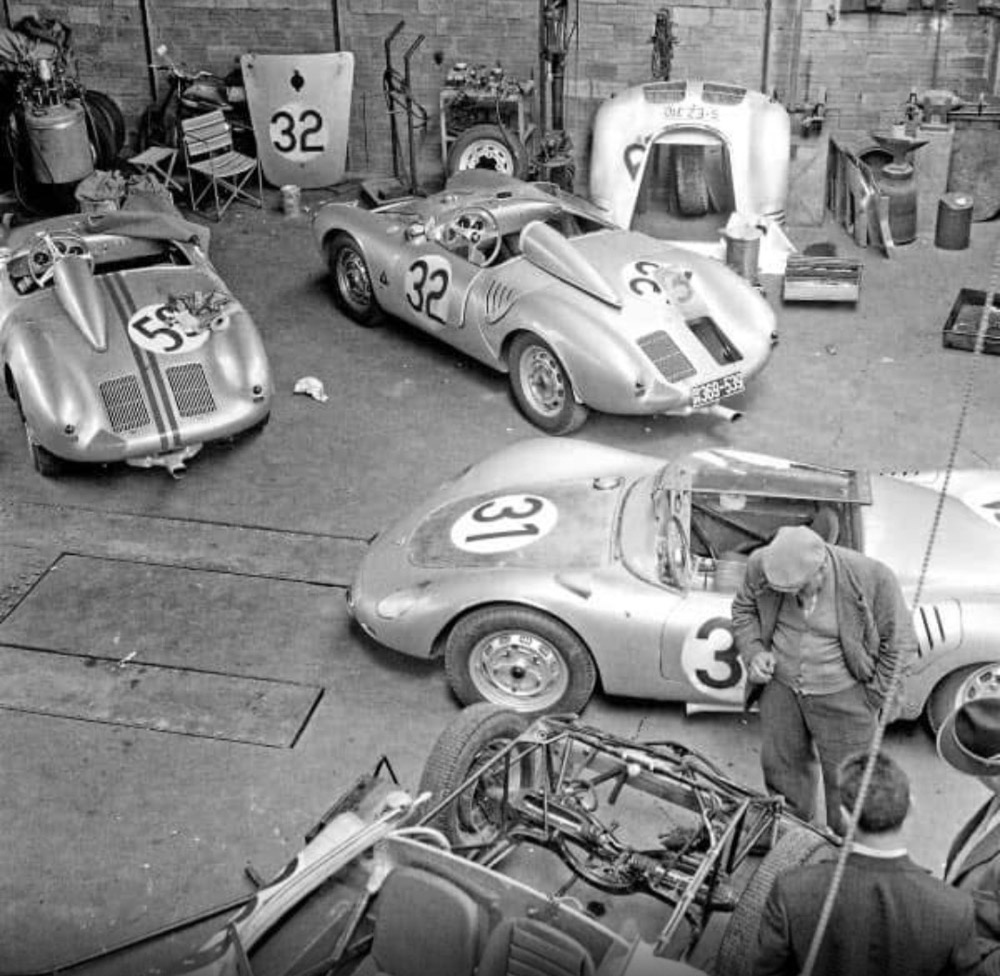
Just a few kilometres south of the Circuit de la Sarthe lies the quiet French village of Teloché. At first glance it appears no different from countless rural communities surrounding Le Mans, yet hidden along one of its streets is a modest garage that occupies a unique place in motorsport history. Long before Porsche became the most successful manufacturer in the history of the 24 Hours of Le Mans, this unassuming workshop served as the team’s operational headquarters and the birthplace of one of endurance racing’s greatest success stories.

A bold return to France
In 1951, only a few years after the end of the Second World War, Porsche made the courageous decision to enter the 24 Hours of Le Mans. It was a remarkable moment. As a young sports car manufacturer founded in 1948, Porsche became the first—and only—German marque to compete in France’s most prestigious endurance race during a period when memories of the war were still painfully fresh.

Much of the credit belongs to Auguste Veuillet, Porsche’s future French importer. Determined to race himself while managing the team’s local logistics, Veuillet searched for a practical base close to the circuit. He found exactly what he needed in Teloché, where local garage owner Georges “Jojo” Després agreed to rent part of his workshop to the German team despite criticism from some neighbours who remained wary of welcoming Germans so soon after the war.
An ideal home away from home
The location proved almost perfect. Situated only a short drive from the circuit, the race cars could travel to Le Mans under their own power rather than being transported by truck. At the time, teams could even access the circuit through a rear entrance near the Mulsanne Straight, avoiding much of the congestion around the main gates.
In the days leading up to the 1951 race, mechanics worked tirelessly inside the small workshop preparing Porsche’s lightweight 356 SLs. Mechanical setbacks meant only one of the intended factory entries ultimately started the race, but that lone survivor exceeded expectations. Driven by Auguste Veuillet and Edmond Mouche, the silver Porsche finished 20th overall while claiming victory in the under-1,100 cc class.

For a young manufacturer making its Le Mans debut, it was an extraordinary achievement. More importantly, it marked the beginning of a relationship with the famous endurance race that continues to this day.
A village becomes part of the team
As Porsche’s racing ambitions expanded throughout the 1950s, 1960s and 1970s, so too did its connection with Teloché. Every June, the village welcomed an ever-growing convoy of engineers, mechanics and drivers. Local families opened their homes, renting spare bedrooms—and sometimes even children’s rooms—to Porsche personnel. Friendships developed that lasted decades, creating an atmosphere unlike anything seen in modern motorsport.
The village café became the team’s dining room. Early breakfasts prepared the mechanics for long days at the circuit, while hot evening meals awaited crews returning well after midnight from practice sessions. The roar of racing engines echoing through the streets during early morning test runs gradually became part of village life rather than a nuisance. Teloché had become, in every sense, Porsche’s French home.
The cars that passed through its doors
During more than thirty years of service, the workshop witnessed an extraordinary parade of Porsche competition cars. Early 356 SLs gave way to the legendary 550 Spyder and 904 Carrera GTS before the arrival of increasingly sophisticated prototypes such as the 906, 907, 908 and the iconic 917. The garage also welcomed machines including the 911 Carrera RSR, 935, 936 and finally the 924 GTP.

Many of the sport’s greatest names walked through its doors. Drivers such as Jacky Ickx, Gérard Larrousse, Helmut Marko and numerous Porsche engineers all prepared for Le Mans within the walls of this modest village garage, long before stepping onto one of motorsport’s biggest stages.
The end of an era
By the early 1980s, endurance racing had entered a new technological age. The arrival of the Group C regulations and increasingly complex race cars demanded extensive support equipment and larger engineering operations directly inside the circuit paddock. The traditional workshop in Teloché could no longer accommodate the needs of a modern factory team. F
ollowing the 1981 Le Mans campaign, Porsche moved its race operations permanently into the circuit facilities, bringing an end to more than three decades of history in the village. Although the factory departed, the building itself remained.
A living piece of motorsport heritage
Today the garage still stands as a working business, remarkably unchanged from the days when Porsche mechanics prepared some of the world’s most famous racing cars behind its doors. Rather than becoming a forgotten relic, it has evolved into a place of pilgrimage for Porsche enthusiasts and Le Mans historians. Owners of classic Porsches regularly visit the site, while special gatherings organised every few years celebrate the remarkable relationship between the village and the Stuttgart manufacturer.

For visitors exploring the Le Mans region, the garage offers something few museums can match: authenticity. The walls, courtyard and workshop witnessed the beginnings of Porsche’s extraordinary endurance racing legacy, long before the marque amassed its record number of overall victories.
The grandstands, pit lane and podium of Le Mans may receive most of the attention, but the true story of Porsche’s endurance success begins several kilometres away, inside a humble village garage where determination, hospitality and engineering excellence came together to create one of motorsport’s most enduring partnerships. And that partnership was celebrated the weekend of the 2026 Le Mans 24H in that same garage. Among others, Derek Bell himself paid a visit to honor the legacy.


