
The history of Porsche in Australia
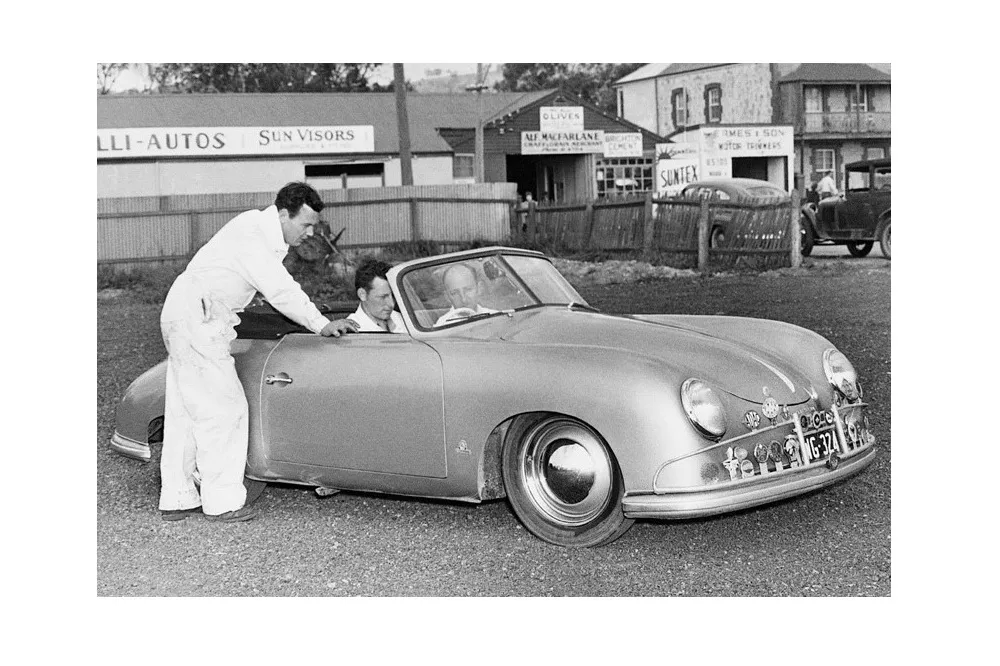
Many Porsche enthusiasts can recall a particular moment when they first fell in love with the brand.
For Melbourne pump distributor Norman McKinnon Hamilton, that defining moment happened when he was 41 years old, during the early summer of 1951, while travelling through Austria’s winding Grossglockner Pass. Hamilton was driving a rented Oldsmobile 88 on his way from Austria to Switzerland to study the latest pump technology for Australia’s ambitious Snowy Hydro project. While navigating one of the pass’s many sharp switchback turns, his large and heavy sedan was suddenly overtaken by a sleek, low-slung silver sports car that effortlessly swept past him.
Chance encounter with Richard von Frankenberg
Later, in a small village higher in the valley, Hamilton came across the same car parked outside a local inn, its engine still ticking with heat. Inside, he met the driver: German racing driver and Porsche test driver Richard von Frankenberg. The two men began talking, and Hamilton’s curiosity about the striking sports car quickly grew.
Von Frankenberg, who had been in the area working on improvements to the car’s chassis, enthusiastically showed Hamilton the vehicle in detail. Intrigued and excited, Hamilton accepted an invitation to visit the Porsche factory. There he was introduced to Ferry Porsche and given a brief tour of the facilities. Before long, Hamilton had secured the commercial rights to sell the rear-engined sports cars in Australia and New Zealand, sealing the agreement with nothing more than a handshake. With that deal, he became only the second official Porsche agent outside Europe, following Max Hoffman in the United States.
Hamilton’s bold decision was very much in character. Born in Preston, Melbourne in 1910, he was known for taking calculated risks. After his father died prematurely, he left school early and began working as an accountant at the National Bank. Despite the long hours, he maintained a strong interest in mechanical engineering and continued studying at night. Eventually he obtained a pilot’s licence, married, and later served in the Air Force during the Second World War.
Following the war, Hamilton purchased a pump manufacturing business in South Melbourne, located on the site where the Crown Casino now stands. One of his first retail customers was Kelly and Lewis Pumps, another pump manufacturer. In 1951, this connection took him to Europe to research high-pressure mining pumps suitable for the Snowy Mountains Hydro-Electric Scheme, a massive infrastructure project that was helping reshape Australia’s economy.
The timing could hardly have been better for someone becoming a Porsche distributor. Only months earlier, the engineering office originally established by Professor Ferdinand Porsche in 1930 had completed its 500th Porsche-badged car since production began in Gmünd, Austria in late 1949. However, nearly all of these cars had been built in left-hand drive. Apart from a single aluminium-bodied coupe made for the Austrian one-armed racing driver Otto Mathé, none had been produced in right-hand drive form.
This detail did not discourage Hamilton. Confident and determined, he negotiated a deal that included a contribution toward the tooling required to convert the cars to right-hand drive.
First Porsches in Australia

The first two Porsche sports cars destined for Australia were a Fish Silver Grey 356 Cabriolet with a split windscreen and a maroon 356 Coupe. According to the arrangement, both cars were to be built in July 1951. Hamilton returned to the factory in August with a friend, Andrew Kennedy, who had worked as a spy during and after the war. Together they collected the two vehicles and drove them across the scenic but demanding roads of the Swiss and Italian Alps to Genoa. From there the cars were shipped to Melbourne, arriving in early October.
Introduction of the Porsches at the South Melbourne Town Hall
On 1 November 1951, Hamilton officially introduced the cars at an event held at the South Melbourne Town Hall. Celebrities and figures from the motorsport community attended the gathering. After the presentation, selected guests were treated to demonstration laps around nearby Albert Park Lake. The cars were driven by Australian Motor Sports Club members Ken Harper and Ken McConville, who showcased the impressive performance of the small sports cars and their 1286cc air-cooled engines. The guests were greatly impressed by the speed and agility of the modest-looking machines.

Remarkably, only forty months after the first Porsche had been granted a road permit in Austria, the brand had now made its way to Australia.
At the time, Norman Hamilton’s son Alan was just nine years old and quickly developed his own enthusiasm for the cars. He later remembered feeling proud whenever his father drove him to school in one of them, convinced that he was arriving in a far more exciting vehicle than any of the other children.
Far from glamorous early years
Despite the excitement, the early years of Porsche in Australia were far from glamorous. Strict import restrictions severely limited the number of vehicles that could enter the country. To supplement his income, Hamilton worked as an insurance loss assessor. He also launched another business called Hamilauto, which produced automotive accessories such as trouble lights and tools for cleaning battery terminals and clamps. One of his partners in this venture was Harold Clisby, who later became the first Porsche dealer in South Australia.
Vehicle numbers increased slowly at first. Only one additional Porsche arrived in 1952, another in 1953, five in 1954 and fifteen in 1955. By 1959 the total had grown to eighty-four. During the 1950s several Porsche tractors and aircraft engines were also brought to Australia for evaluation. Meanwhile, Porsche industrial engines based on the later 1600cc car engines were used by Australia’s Antarctic Division for over-snow vehicles, and by operators in the Snowy Mountains region. In this way, Porsche engineering quietly contributed to several aspects of Australia’s post-war development.
The company’s first Australian office operated under the name Australasian Lloyd Pty Ltd and was located on the eighth floor of the Southern Cross Assurance building at 315–317 Collins Street in Melbourne. The showroom itself was far less formal: cars were simply displayed at the kerb outside, while local parking officers were encouraged to overlook the unusual arrangement.
Public awareness of Porsche grew significantly in 1953 when Hamilton and Ken Harper entered one of the low-slung coupes in the first REDeX Reliability Trial, a gruelling 10,400-kilometre journey around Australia. The car endured rough roads and harsh conditions as it bounced and scraped its way across the country. Hamilton carried few spare parts, but he did pack more than a dozen pairs of shoes in case he encountered potential customers or well-known personalities along the route.
Racing & Motorsport
As sales slowly improved, young Alan Hamilton became familiar with many racing drivers and motorsport figures who were drawn to the new sports cars. He also spent time at Moorabbin Airfield watching his father build light aircraft. By the age of twelve, Alan had decided that he wanted to become a racing driver himself. Like many aspiring racers of the era, he and his friends—among them future Formula One world champion Alan Jones—began driving their fathers’ cars while still very young.
Although Alan’s own racing career ended prematurely after a serious accident at Sandown Raceway in 1978, the Porsche business in Australia continued to expand.


By the mid-1980s sales were thriving, with 660 cars sold in 1985 and 657 in 1986. The introduction of new front-engined transaxle models such as the 924, 944 and 928 meant the company needed larger and more visible premises. In the late 1980s Hamilton made a bold move by purchasing and renovating the large former Bryant & May match factory in Church Street, Richmond. Unfortunately, the economic recession that began in 1989 soon created serious financial pressure.
The situation reached its conclusion in February 1992, when Porsche AG assumed direct control of all Porsche operations in Australia. This ended 41 years of management by the Hamilton family, whose efforts had established a strong foundation for the brand’s long-term presence in the Australian automotive industry.
Sadly, Norman Hamilton did not live to witness this transition. He passed away only a month before Porsche Cars Australia was officially formed following the takeover by the company’s headquarters.
Edited press release Porsche Australia
Pictures ©Porsche AG

