
Porsche Flachbau RS: When a 911 GT2 RS becomes a modernMoby Dick
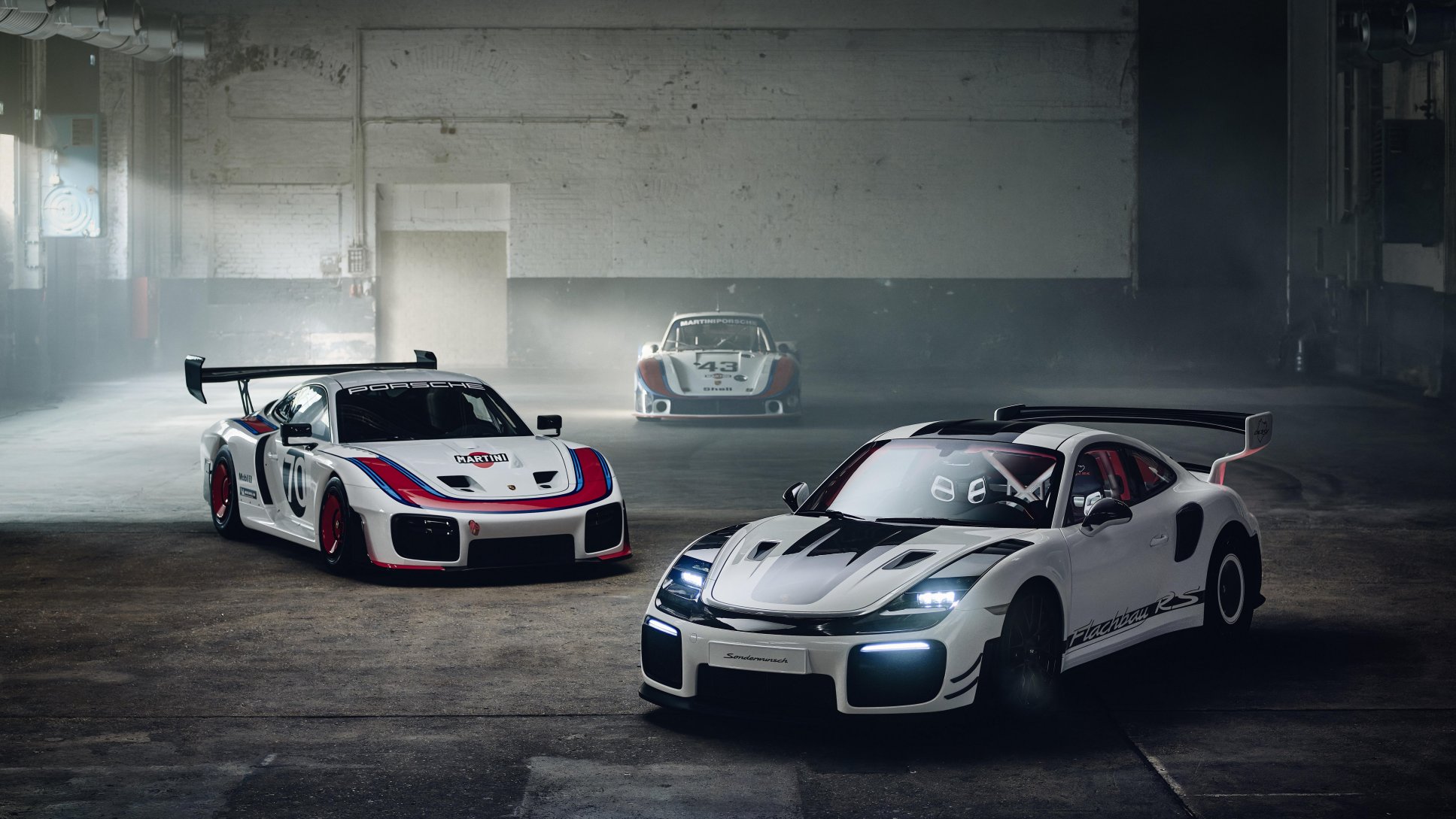
There are special Porsches, and then there are Porsches that feel as though they have escaped from an alternate chapter of the company’s history. The new Porsche 911 Flachbau RS belongs firmly in the second category.
Created through Porsche’s Sonderwunsch programme, this one-off machine takes a 2018 911 GT2 RS with the Weissach Package and transforms it into something far more unusual: a modern interpretation of the legendary 935/78 “Moby Dick”, complete with a dramatically reshaped front end, a bespoke rear wing and an uncompromising approach to weight reduction. And unlike many one-off show cars, this Porsche was engineered to be driven.
A modern take on Porsche’s most famous slantnose
The inspiration is unmistakable. The 935/78 earned its “Moby Dick” nickname thanks to its elongated, almost whale-like silhouette. Developed from the 911 Turbo, the 935 became one of Porsche’s most successful racing cars, collecting championships and major endurance-racing victories throughout its career.

Its influence on the Flachbau RS is most obvious from the front. The standard GT2 RS nose has been replaced by a much lower, more sculpted interpretation of the classic slantnose profile. The front wings feature distinctive louvred outlets designed to evacuate air from the wheel arches, while the entire front bumper has been redesigned.
Even the headlights had to be reconsidered. Instead of the familiar round 911 units, the Flachbau RS uses three slim LED elements arranged vertically. The result is an unusually low and aggressive face that immediately separates this car from any production 991-generation 911.
It looks like a Porsche that has been pulled forward from a racing archive and rebuilt with modern technology.
The details make the difference
The colour scheme reinforces the connection with Porsche’s racing heritage. The body is finished in Grand Prix White, a colour that Porsche introduced for the 911 in 1974. Black details and exposed carbon fibre provide the contrast, while the bonnet and roof feature an inverted interpretation of the graphics normally associated with the GT2 RS.

The most recognisable element is the U-shaped black section at the front of the car. It is a deliberate reference to the famous livery of the 935/78 “Moby Dick”, but the execution is distinctly modern.
The rear is no less dramatic. The Flachbau RS receives a new carbon-fibre rear wing mounted on distinctive S-shaped supports. The design takes inspiration from the wing of the 992-generation 911 GT3 R rennsport, but Porsche has made it approximately five centimetres taller for this application.

The wing can be manually adjusted between three positions depending on the intended use. In the high-downforce configuration, Porsche claims the car to produce 554 kg of downforce on the rear axle at 340 km/h. That is not merely decoration. This Flachbau was built with aerodynamics very much in mind.
Manthey engineering meets Sonderwunsch craftsmanship
The project was far more complicated than simply reshaping a few body panels. Porsche brought together specialists from Sonderwunsch, Style Porsche, Weissach development, Porsche Motorsport and Manthey. The entire project took almost three years.

The car retains its original drivetrain, but practically everything around it was scrutinised.The front splitter and underbody components from the Manthey Kit work together with the rear diffuser to improve aerodynamic performance. Carbon-fibre rear-wheel aerodiscs help reduce drag, while the new bodywork was subjected to extensive aerodynamic analysis.
And then there was the weight. Even though the starting point was already a Weissach-equipped GT2 RS designed with weight reduction in mind, Porsche managed to remove another 31.6 kilograms. That figure may sound modest until you consider what the engineers were starting with.
A cabin stripped back to its essentials
Inside, the same philosophy continues. The front portion of the cabin retains the red Alcantara, black leather and exposed carbon-fibre character of the original car. Behind the seats, however, the transformation is much more radical.
The Porsche Communication Management system is gone. So is the audio system. Much of the sound insulation, carpeting and other comfort-oriented equipment has been removed. What remains is closer to a road-legal racing environment than a conventional luxury sports car interior.

Some of the exposed components are deliberately finished in Grand Prix White, while selected areas receive carbon-fibre trim. Even the wiring has been treated as part of the weight-saving exercise. The carbon-fibre bucket seats carry “Flachbau RS” embroidery, accompanied by a stylised Nürburgring Nordschleife outline. A gold-coloured Sonderwunsch badge on the dashboard identifies the car as a “Factory One-Off 2026”.
It is the sort of detail that enthusiasts will appreciate precisely because it isn’t trying too hard to impress.
Porsche didn’t just build it. It tested it.
This is perhaps the most interesting part of the Flachbau RS story. With such a radical change to the bodywork, Porsche couldn’t simply rely on computer models and visual inspection.The project went through digital validation, crash-related simulations, airbag deployment analysis, structural calculations and CFD aerodynamic development before new tooling was produced.
The rear wing received its own programme of testing, including vibration testing and static load tests. Then came real-world validation.Porsche built three test cars and subjected the design to lighting- and wind-tunnel testing, road testing and extensive track work.

There were test sessions at Mendig airfield, endurance testing at Weissach and 50 laps of the Nürburgring Nordschleife. According to Porsche, the testing programme subjected the rear wing to loads equivalent to approximately 150,000 kilometres of customer use. That is an extraordinary amount of engineering effort for a car that exists only once.
And then there is the Nürburgring
The Nordschleife is where a project like this ultimately has to make sense. Porsche test driver Lars Kern was among those who drove the Flachbau RS around the famous circuit. His assessment was particularly relevant given the radical aerodynamic changes: despite its unusual bodywork, the car remained stable and precise at very high speeds.

That is exactly what Porsche needed to prove. A Flachbau-inspired GT2 RS that merely looked spectacular would have been interesting. A Flachbau-inspired GT2 RS that actually behaves like a serious Porsche GT car is something else entirely.
Interestingly, the disguised prototype also attracted attention before Porsche officially revealed the finished car. Videos of the camouflaged slantnose machine running at the Nürburgring reportedly generated more than 100,000 social-media views within just a few hours.
Clearly, Porsche wasn’t the only one curious about what was hiding underneath the camouflage.
The mystery behind “Flachbau RS”
There was another clue before the car itself appeared. In May 2025, Porsche registered the names “Flachbau” and “Flachbau RS” with the European Patent Office. For Porsche followers, that immediately raised questions. Now we know why.
The company was preparing the name for this extraordinarily elaborate Sonderwunsch project.And the choice makes perfect sense. The Flachbau name has been part of Porsche history since the 1980s, when the company offered a radically redesigned version of the 930-generation 911 Turbo with a slantnose front inspired by the 935 racing cars.
Between 1982 and 1989, Porsche sold 948 examples of that factory-built Flachbau. Even today, genuine examples remain among the rarest and most desirable 911 variants.The new Flachbau RS doesn’t attempt to reproduce that car.
A Porsche that will never have a successor
The Flachbau RS is a factory one-off. There will not be a production run of 50 cars. There won’t be a special edition dealer allocation. There isn’t a configurator where another customer can simply order the same specification. There is this car. And that makes the project particularly significant for Porsche enthusiasts.
It is a reminder that, even in an era when increasingly complex performance cars are developed according to strict production programmes, Porsche still has the ability to build something completely unique when the right customer, the right idea and the right engineers come together.
The original 935 “Moby Dick” was created to win races. Decades later, its silhouette has inspired a road-legal GT2 RS that is almost certainly destined to become an object of fascination for collectors. It may never dominate Le Mans. It doesn’t need to.
The Flachbau RS has already achieved something different: it has taken one of Porsche’s most recognisable racing shapes and given it another life. And for a Porsche enthusiast, there are few better reasons for a one-off to exist.
Porsche Raceborn Methods
Pictures & Video © Porsche


