
Double Champion: Peter Gregg’s 1973 IMSA GT and SCCA Trans-Am Seasons
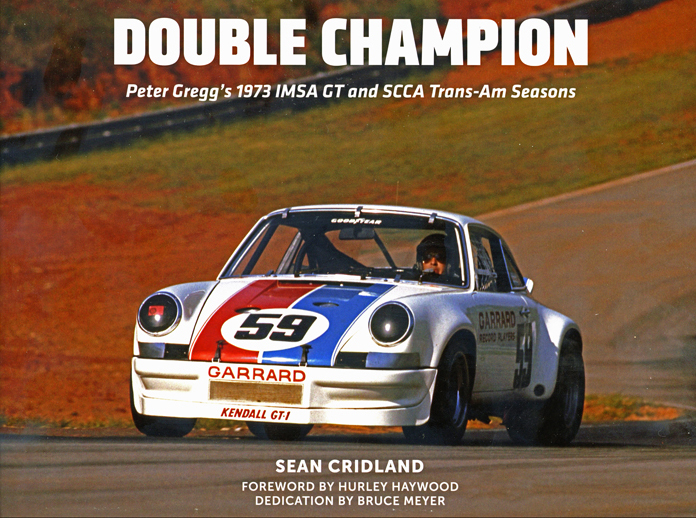
Sean Cridland’s Double Champion: Peter Gregg’s 1973 IMSA GT and SCCA Trans-Am Seasons is more than a motorsport biography—it is a carefully reconstructed portrait of a turning point in American road racing, anchored around one of its most complex and gifted figures. The book succeeds on two levels: as a detailed chronicle of a dominant racing season, and as a window into an era when professional road racing in the United States was still finding its identity.

At its center is Peter Gregg, a driver whose name is inseparable from Porsche’s rise in North American endurance and GT racing. Gregg’s 1973 season is the narrative spine of the book, but Sean Cridland uses it as a lens to explore broader themes: the evolution of IMSA and Trans-Am competition, the increasing sophistication of race engineering, and the intensifying professionalism of motorsport in the 1970s.
Cridland, who has built a reputation as a meticulous historian of Porsche racing culture, writes with the authority of someone deeply embedded in the subject. His previous works on Brumos Racing and Hurley Haywood established his ability to blend archival research, technical detail, and human storytelling, and Double Champion continues that trajectory.

The “double champion” title refers to Gregg’s extraordinary achievement in 1973: competing at the highest level in both the IMSA GT Championship and the SCCA Trans-Am Series simultaneously, while remaining consistently competitive in both. This feat alone would be impressive in any era, but in the early 1970s it bordered on the exceptional. Where Cridland’s work is particularly effective is in illustrating how Gregg’s dual-campaign season influenced the perception of what was possible in professional racing at the time. Competing across multiple series today is rare at the highest levels, but in 1973 it was still conceivable for elite drivers.

From a narrative standpoint, the book also does a strong job of balancing triumph with tension. Gregg’s career, while successful, was not without complexity. Cridland does not reduce him to a simple heroic figure; instead, he is portrayed as intensely driven, sometimes difficult, and deeply committed to winning. This adds depth to the story and prevents it from becoming purely celebratory.

If there is a limitation to Double Champion, it is that its depth of detail may occasionally overwhelm readers unfamiliar with the specifics of 1970s American racing series. The book assumes a degree of prior interest or knowledge in Porsche motorsport history. However, for those willing to engage with its level of detail, it becomes an absorbing reconstruction of a formative era.

Ultimately, Double Champion succeeds because it captures more than a season—it captures a shift in motorsport identity. Through the lens of Peter Gregg and his 1973 campaigns, Sean Cridland documents a moment when technology, professionalism, and driver versatility intersected in a way that would soon become rare. The book stands as both a tribute and a historical document.
For readers interested in the roots of modern GT racing, the rise of Porsche in North America, or the evolution of driver professionalism, Cridland’s work offers a detailed and rewarding account of a season that helped define an era.
And honestly, there are no valid excuses not to buy the book, when you know the price is only $49.95
Book details

Title: Double Champion
Subtitle : Peter Gregg’s 1973 IMSA GT and SCCA Trans-Am Seasons
Author: Sean Cridland
Publisher: Visions of Power
Genre: Motorsport
Release Date: 2026
Format: Hardcover
Pages: 195 pages
Pictures: 255 and illustrations
Language: English
Price: $49.95
All pictures ©Visions of Power


