
Restored Porsche 911 2.5 S/T @Techno Classica
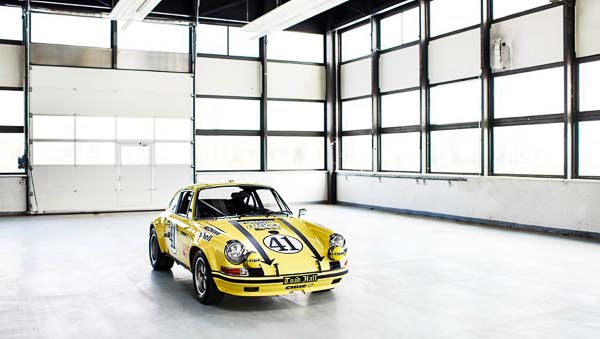
The Porsche 911 2.5 S/T at 24 Hours of Le Mans 1972
After the extensive metalwork had been completed, the body of the 911 2.5 S/T was coated by cathodic dip painting (CDP) to protect it long-term against corrosion according to the highest technological standards of series production. This was done by putting the restored body through the current series production process at Porsche to give it perfect protection against corrosion. This was then followed by body finishing and painting in the original light yellow colour, code 117.

Motor racing, in particular the Le Mans 24 Hours race, is of great significance to Porsche. Over 800 Porsche vehicles have taken part since the first race took place in 1951, with 103 of them taking a class victory and 17 overall victories at the circuit on the river Sarthe, Porsche is the most successful brand there by far. After winning last year, Porsche is all set to take part in the 84th Le Mans 24 Hours race on June 18 and 19 this year.
Race track as testing ground for new technologies
Traditionally for Porsche, a race like the 24 Hours of Le Mans is not only about competing at the highest level. Rather, the race track is more of a testing ground for new technologies. The development of successful race cars like the 919 Hybrid and the 911 RSR as well as being put to the test under tough racing conditions offer critical insights that can be incorporated in to the design of future generations of production models. This type of technology transfer from race car to standard vehicle as the driving force behind Porsche’s motorsport involvement was already in Ferry Porsche’s mind when he said: “Technical progress is unthinkable without sport. It is the vector for development. The extreme demands we face on the race track very quickly highlight any weak points and encourage our engineers to look for new and better solutions.”
Seen in this light, the 911 2.5 S/T restored by Porsche Classic down to the last detail can be see from a historical point of view, too. It was the direct predecessor and the immediate technical precursor for the 911 Carrera 2.8 RSR, which saw the abbreviation “RSR”, which stands for RennSport Rennwagen (literally: racing sport racing car) become the epitome for the highest stage of development of the 911 racing cars from 1973 onwards and heralded the continuous technological improvement of the production 911, in keeping with Ferry Porsche’s philosophy.
The 911 stands for Porsche brand like no other series
Having now been on the market for over five decades, the 911 – which is now in its seventh generation – stands for the Porsche brand like no other series. Porsche Classic is now already taking care of the fifth generation of this iconic sports car (Type 996). The Classic experts cater for all vehicle model series whose production was phased out at least ten years ago, in order to continue to guarantee smooth service and assure long life and value preservation for classic Porsche vehicles.


